- Join Dubai’s Leading Technical Training Institute Today!
- 50 6914688
- info@solvetechtraining.com


How to Choose the Right Professional Training Institute in Dubai
June 4, 2026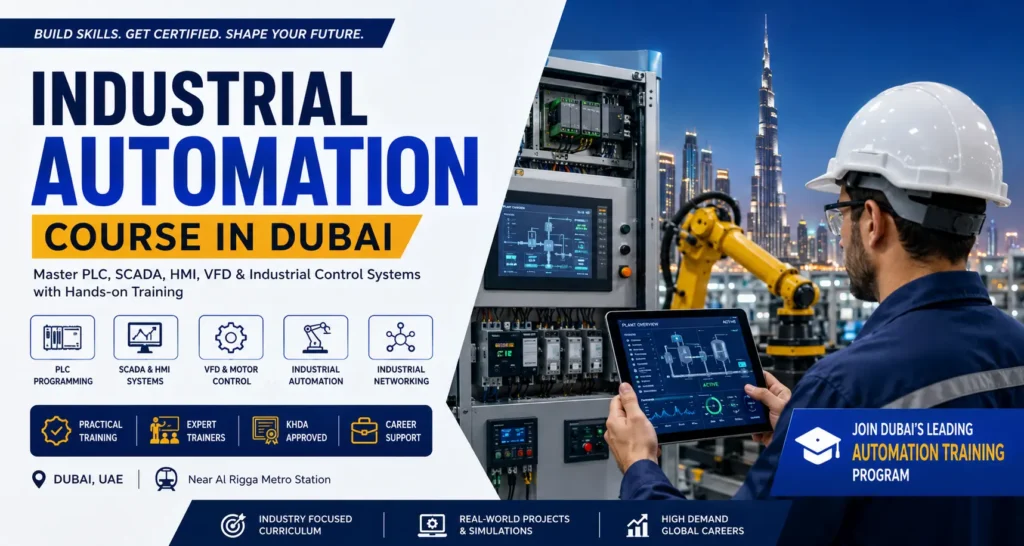
Industrial Automation Course in Dubai: Learn PLC, SCADA & Control Systems
Build practical automation skills with industry-focused training in PLC, SCADA, HMI, VFD, DCS and industrial control systems in Dubai.
What's Inside
- Why Industrial Automation Is a Smart Career Choice
- Why Choose Industrial Automation Training in Dubai?
- What You Learn in an Industrial Automation Course
- PLC Programming: The Core of Industrial Automation
- SCADA, HMI & Industrial Control Systems
- VFD, Sensors, Motors & Industrial Communication
- Who Should Join an Industrial Automation Course?
- Career Opportunities After Automation Training
- Why Choose Solve Tech Training in Dubai?
- Frequently Asked Questions
Industrial automation is changing how modern factories, production facilities, utilities and engineering operations work. Machines are becoming smarter, processes are becoming more connected, and companies need professionals who understand how control systems work in the real world.
That is why an industrial automation course in Dubai can be a valuable career move for engineers, technicians, fresh graduates and working professionals who want to build practical skills in automation and control.
But learning automation is not simply about understanding PLC programming from a textbook. A good industrial automation training in Dubai should help you understand how PLCs, SCADA, HMI, VFDs, sensors, motors, communication systems and control logic work together.
"Automation skills become much more valuable when you can apply them to real industrial problems — not just explain the theory."
Why Industrial Automation Is a Smart Career Choice
Industrial automation sits at the intersection of electrical engineering, electronics, instrumentation, software and mechanical systems. That makes it a highly practical technical field with applications across multiple industries.
Automation systems are used to control machines, monitor processes, manage production lines, improve operational efficiency and identify faults. As businesses adopt smarter and more connected technologies, professionals who can understand and troubleshoot these systems can add significant value.
- PLC-based machine and process control
- SCADA monitoring and supervisory control
- HMI design and operator interfaces
- Motor control and VFD applications
- Industrial sensors and actuators
- Industrial networking and communication
- Troubleshooting and preventive maintenance
- Industry 4.0 and smart automation concepts
For someone looking to move into automation engineering, controls or industrial maintenance, structured practical training can provide a much stronger starting point than theory alone.
Why Choose Industrial Automation Training in Dubai?
Dubai has developed into a major business, engineering and technology hub, making it an attractive location for professionals looking to upgrade technical skills.
For automation professionals, learning in Dubai also means being exposed to the type of engineering environment where automation, electrical systems, instrumentation, smart technologies and industrial controls intersect.
| Area | Skills You Can Develop | Career Relevance |
|---|---|---|
| PLC | Ladder logic, programming, I/O and control logic | Automation & Controls |
| SCADA | Monitoring, alarms, data acquisition and visualization | Process & Control Systems |
| HMI | Operator interfaces and machine visualization | Machine Automation |
| VFD | Motor speed and drive control | Electrical & Maintenance |
| Instrumentation | Sensors, actuators and process measurement | Process Industries |
| Industrial Networking | Modbus, PROFIBUS, Ethernet/IP and related systems | Connected Automation |
What Do You Learn in an Industrial Automation Course?
A comprehensive industrial automation course in Dubai should take you beyond basic programming and show you how different automation components work together.
At Solve Tech Training, the industrial automation curriculum covers technologies including PLC, SCADA, DCS, HMI, VFD, electrical control panels, industrial communication and troubleshooting. :contentReference[oaicite:3]{index=3}
Key areas covered include:
- PLC hardware and programming
- Ladder logic and control logic
- SCADA configuration and monitoring
- HMI development and integration
- DCS fundamentals
- VFD setup and motor control
- Sensors and actuators
- Electrical control panel concepts
- Industrial communication protocols
- Automation troubleshooting and maintenance
- Industry 4.0 and IoT concepts
PLC Programming: The Core of Industrial Automation
If you are searching for PLC training in Dubai, it is important to understand why PLCs are such an important part of automation.
A Programmable Logic Controller receives signals from field devices, processes programmed logic and sends commands to connected equipment. PLCs are widely used for machine control, sequencing, monitoring and industrial processes.
Practical PLC training can include ladder logic, digital and analogue I/O, control sequences, communication and fault diagnosis.
Solve Tech's PLC training also covers areas such as HMI integration, communication protocols, simulation projects, diagnostics and real-time industrial applications. :contentReference[oaicite:4]{index=4}
SCADA, HMI & Industrial Control Systems
PLC programming is only one part of industrial automation. Modern systems also rely on interfaces and supervisory platforms that allow operators and engineers to monitor processes.
SCADA Training
SCADA — Supervisory Control and Data Acquisition — is used for monitoring, data acquisition, alarms and supervisory control. Learning SCADA gives automation professionals a better understanding of how industrial processes are visualized and monitored.
HMI Training
Human Machine Interfaces allow operators to interact with machines and processes. HMI training can cover screen design, visualization, alarms, data handling and communication with PLC systems.
DCS & Process Control
For professionals interested in process industries, understanding Distributed Control Systems and process control can add another layer to their automation knowledge.
Solve Tech's current automation training information includes SCADA, HMI, DCS and process-control technologies as part of its automation-focused programs. :contentReference[oaicite:5]{index=5}
VFD, Sensors, Motors & Industrial Communication
Real automation systems involve much more than PLC code. A strong industrial automation training course should help you understand the devices connected to the control system.
- VFDs: Understand variable frequency drives and motor-speed control.
- Sensors: Learn how field devices provide information to the control system.
- Actuators: Understand how control signals create physical actions.
- Motors: Learn the basics of industrial motor applications.
- Communication: Understand how PLCs and other industrial devices exchange data.
- Troubleshooting: Develop a systematic approach to diagnosing automation faults.
These skills become especially useful when working on commissioning, maintenance, machine automation and control-system projects.
Who Should Join an Industrial Automation Course?
You do not necessarily need years of automation experience to start. The right learning path depends on your current technical background and career goal.
- Electrical and Electronics Engineers
- Instrumentation Engineers
- Mechatronics Engineers
- Mechanical Engineers interested in automation
- Electrical and maintenance technicians
- PLC and control-system professionals
- Engineering students and fresh graduates
- Professionals moving into Industry 4.0
- Maintenance professionals looking to upgrade their skills
Solve Tech's PLC training is also positioned for engineering students, working professionals, technicians, job seekers and companies training employees. :contentReference[oaicite:6]{index=6}
Career Opportunities After Industrial Automation Training
Completing an automation course does not automatically guarantee a job, but practical skills in PLC, SCADA, HMI and control systems can strengthen your technical profile for several career paths.
| Career Path | Relevant Skills |
|---|---|
| Automation Engineer | PLC, SCADA, HMI, control systems |
| PLC Programmer | Ladder logic, PLC programming, troubleshooting |
| SCADA Engineer | SCADA, alarms, monitoring and data acquisition |
| Control System Engineer | PLC, DCS, process control and industrial networking |
| Instrumentation Engineer | Sensors, process control and instrumentation |
| Maintenance Engineer | Fault finding, VFDs, motors and automation maintenance |
| Commissioning Specialist | Testing, configuration and troubleshooting |
Solve Tech identifies career paths including Automation Engineer, PLC Programmer, Control System Designer, Instrumentation Engineer and Maintenance and Commissioning Specialist for learners completing its automation training. :contentReference[oaicite:7]{index=7}
Why Choose Solve Tech for Industrial Automation Training in Dubai?
Choosing an industrial automation training institute in Dubai is an important decision. The course should match your career objective, current technical level and preferred learning format.
Solve Tech Training Institute offers automation-focused programs covering PLC, SCADA, HMI, DCS, VFD and industrial control technologies, with an emphasis on practical and industry-relevant learning. :contentReference[oaicite:8]{index=8}
- Practical learning: Focus on skills that can be applied to real automation scenarios.
- Industry-focused curriculum: PLC, SCADA, HMI, VFD, DCS and control systems.
- Expert trainers: Training is delivered by professionals with field experience.
- Flexible batches: Weekday and weekend learning options are available.
- KHDA-approved training: Solve Tech operates as a KHDA-approved training provider.
- Career guidance: Learners can receive career-oriented guidance alongside technical training.
- Dubai location: The institute is located near Al Rigga Metro Station in Deira.
Solve Tech's official information lists its Dubai office at Mabrooka Building 04, Deira Clocktower, Al Muraqqabat Road, near Al Rigga Metro Station Exit 2. :contentReference[oaicite:9]{index=9}
Ready to Build Your Automation Skills?
Explore the Industrial Automation Course in Dubai at Solve Tech Training and learn PLC, SCADA, HMI, VFD and industrial control systems with practical, career-focused training.
The Bottom Line
An industrial automation course in Dubai can be a strong step for professionals who want to move deeper into automation, controls, instrumentation or industrial maintenance.
But don't choose a course simply because it promises a certificate. Look at what you will actually learn, whether you get practical exposure, who is teaching you, which automation technologies are covered and how well the course matches your career goal.
PLC, SCADA, HMI, VFD, DCS and industrial communication are not isolated technologies. They are parts of a larger automation ecosystem. Learning how these systems work together is what can turn basic technical knowledge into a more useful professional skill set.
If you're ready to take that next step, explore Solve Tech Training's industrial automation programs in Dubai and choose a learning path that matches where you want your career to go.
Frequently Asked Questions
What is an industrial automation course in Dubai?
An industrial automation course teaches professionals how automated industrial systems work, including PLC programming, SCADA, HMI, VFD, DCS, sensors, industrial communication and troubleshooting.
What will I learn in industrial automation training?
Depending on the program, you can learn PLC programming, ladder logic, SCADA systems, HMI configuration, DCS fundamentals, VFD operation, sensors, actuators, industrial communication and automation troubleshooting.
Who can join an industrial automation course?
Industrial automation training can be suitable for electrical, electronics, instrumentation, mechanical and mechatronics engineers, technicians, engineering students, fresh graduates and working professionals looking to move into automation.
Is PLC training included in industrial automation courses?
Yes. PLC programming is a core component of industrial automation training. Solve Tech's PLC-focused training covers programming, communication, HMI integration, simulations, diagnostics and industrial applications. :contentReference[oaicite:10]{index=10}
Can I learn industrial automation while working in Dubai?
Yes. Flexible training options can make it easier for working professionals to learn around their existing schedules. Solve Tech offers weekday and weekend training options for its automation programs. :contentReference[oaicite:11]{index=11}
What jobs can I pursue after industrial automation training?
Potential career paths include Automation Engineer, PLC Programmer, SCADA Engineer, Control System Engineer, Instrumentation Engineer, Maintenance Engineer and Commissioning Specialist. :contentReference[oaicite:12]{index=12}
Where is Solve Tech Training Institute located in Dubai?
Solve Tech Training Institute's Dubai office is located at Mabrooka Building 04, Deira Clocktower, Al Muraqqabat Road, near Al Rigga Metro Station Exit 2. :contentReference[oaicite:13]{index=13}
Does Solve Tech offer a free demo for industrial automation training?
Solve Tech promotes free demo classes for its training programs. Contact the institute directly to confirm the current demo availability and schedule for industrial automation training.